Watercarriers
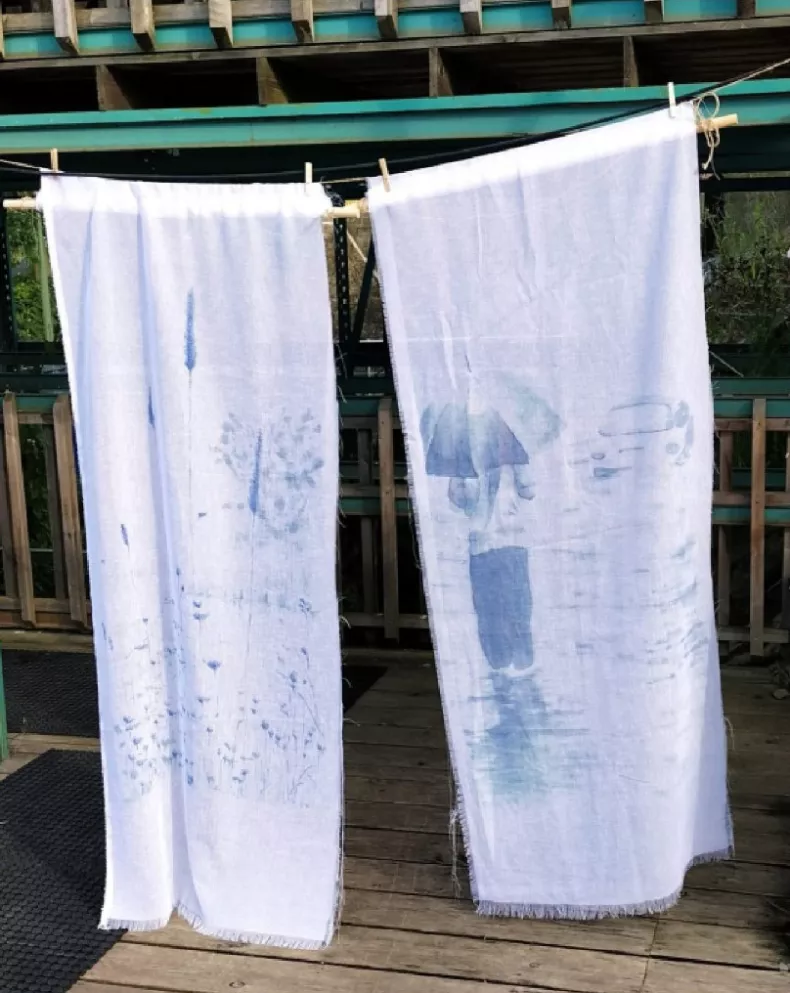
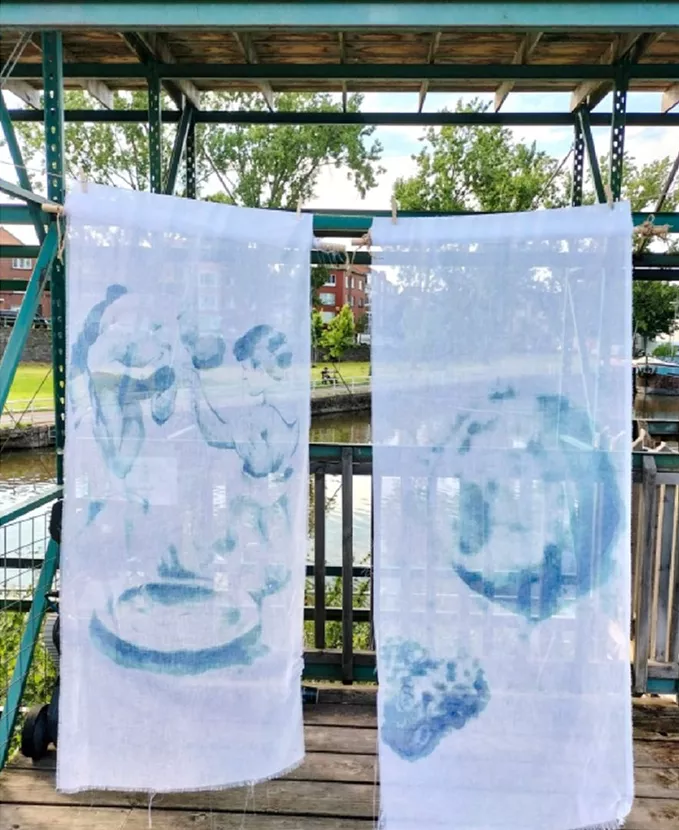
The watercarriers are a reinterpretation of a well know Art Nouveau figure. We proposed to reinterpret it through the creation of four scene. Each one address poetically current sociospatial concerns.
a. LOVE: Source of love:
*'The invisible is the visible that's not seen yet'*
M. Duchamps.
In the heart of a Brussels park, the arrival of a natural water spring unfolds its legends. Lovers who drink water from this spring are guaranteed eternal love. The appearance of an usually invisible underground water becomes a source of inspiration for artists and of wonder for kids and adults.
This waterspring is a considerable ally in explaining the main principles of the valley's soils. Water, infiltrated within the sandy geological layers (water carriers) magically resurface once it meets the impermeable clay layers
b. SYMBOL : Marsh landscape:
A symbolic, sensitive landscape, well known in Brussels (Bruocsella, the house on the marsh in Germanic). A watercarrier landscape that has been the focus of public and ecological resistance in the past few years to preserve and restore this landscape in the heart of our urban fabric. This fragile landscape has a very important role in the ecological and climatic adaptation of the city, it is a richly biodiversity biome, a powerful carbon sequestration and refreshing environment with a cultural and educative impact.
c. +2M : Floods: nothing natural but a human disaster
Water is frequently seen as a dual component, both a force for life and a destructive power. Lack of water worries us, too much water terrifies us. In 2021, Belgium experienced deadly floods that left a lasting mark in our memories and imaginaries. These floods raised a number of questions,among them: what is the space given fort he water? How do we collectively accept to live "at risk" that we ourself generated?
d. 80cm : Interstellar water carriers:
This fabric has two dimensions, the first one poetic, as hydrologist Emma Haziza says1., the water cycle is not closed, it is in equilibrium. Our planet leaks water from its atmosphere, compensated for by the water brought down by comets.
The second one is more dramatic, it provides an opportunity to appreciate the scale of our staggering impact on this planet. Since 2022, we have exceeded the 6th planetary limit, that of the freshwater cycle, and we now know that the over-exploitation of groundwater and its non-renewal has changed the Earth's axis of rotation by almost 80cm.
Watercarriers as a cultural act
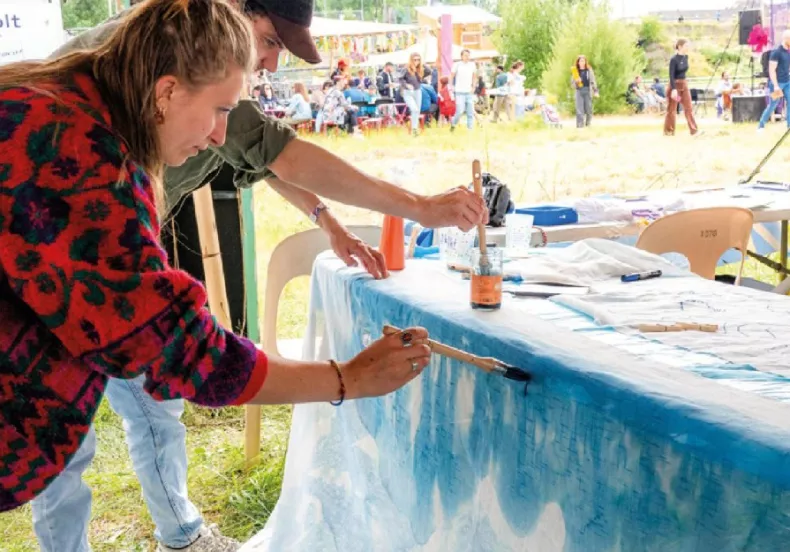
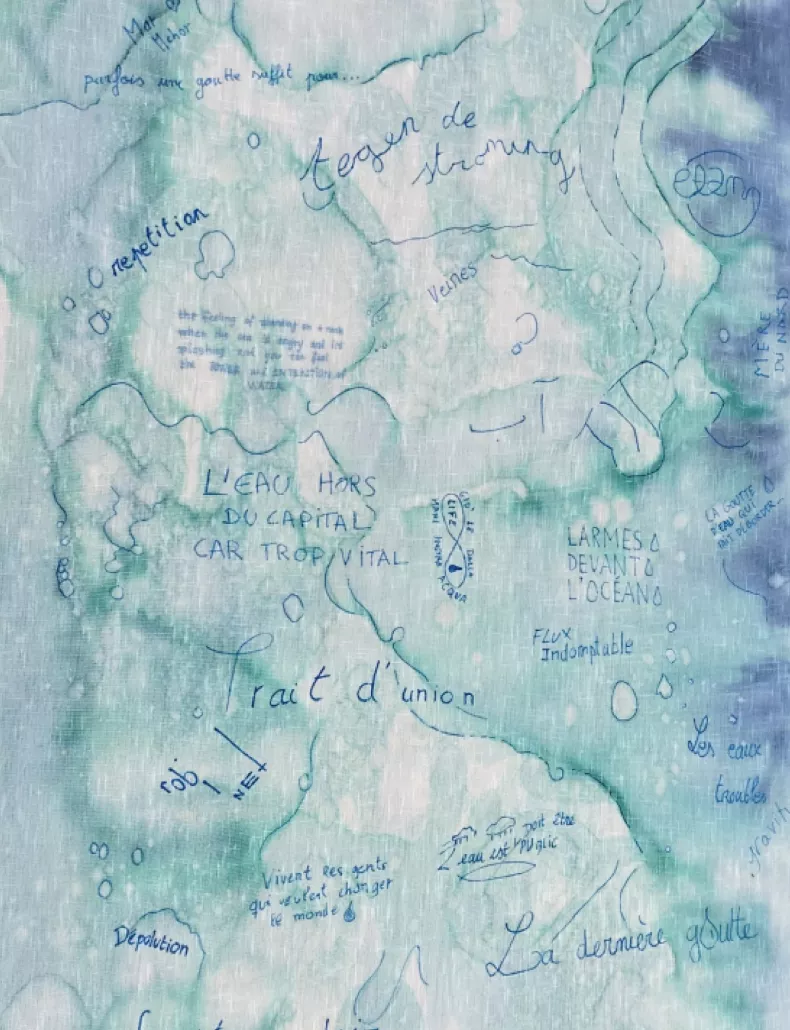
The two days of the Fluctuations festival gave us an opportunity to share and explore our relationship with water. Throughout the workshop, a large fabric has been painted collectively by the festival participants. Starting as a blank canvas for the participants imaginaries it materialised the people's stories, interweaving and superimposing them. The water and ink used are mixed, diffused like a fluid, inter-connected multicellular organism.
As the festival unfolds, multicultural, cross-generational and sometimes contradictory narratives are revealed. The metaphysical and geological imaginaries, the political wins and hopes (Mar Menor, a Spanish lagoon which, following a popular initiative, obtained the status of a legal entity), the worries (la dernière goutte) the shared dimension of this vital element (a common good must be public, free from capital). It also has capacity to bring people together (un trait d'union), it could be a rebellious, agitating force (la goutte d'eau qui fait déborder…).
The sharing of these imaginaries also offers us hidden gems related to childhood and learning (the word "water" is written in Persian ﺁﺏ (ÂB) first word learned to write. And his shape seems to convey the watercycle).
Each of these moments confirms that transmission and sharing are essential tools in our practices, preventing the trivialisation of imaginaries and recreating links. At such a special time, at the crossroads of an economic, ecological and socio-political crisis with the raise of the extreme right, conservative forces helped by the support of liberal and capitalist world desperate to keep control, we need to fight and find a collective sustainable fairground. At a time of struggle and popular uprising, where the democratic stakes of conflict and debate happen, and when cultural hegemony needs to be regained, we see our role as landscape architects not just as architects of open spaces or technicians, but as facilitators and mediators of new ways of co-existing with the living.